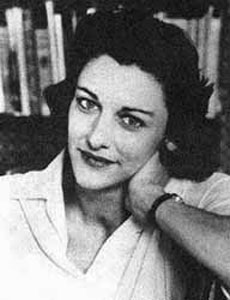
After reading Anne Sexton's "Her Kind" I immediately realized something: I had no idea what I had just read. So of course, being the diligent student I am, I re-read it enough times to make at least some sense of it. As I read the lines over and over again, it became clear that Sexton (who I am quite sure is the speaker) had severe mental problems. I don't mean that as a joke, I really do mean that there was something wrong with her. "Her Kind" is a poem that is dripping with sadness, regret, and depression. The speaker is truly suffering, so as the readers, we should open our eyes to her pain.
Sexton's reason for using words such as "possessed," "haunting," and "out of mind" in the first line is because the speaker has been taken over by her mental state. She has thought of doing "evil" to others because she suffers from a lack of appreciation. Important to the understanding of the poem is Sexton's own life. Sexton suffered from bipolar disorder for the last twenty years of her life. After much psychotherapy, she still believed that her existence was meaningless, and that her future was hopeless. Although I do not believe Sexton's poem is an autobiography, I do believe knowing this key fact makes it easier to understand the meaning of this complicated (and even at some times, ambiguous) poem.
Sexton's underlying tone is very feminist. By calling herself a "possessed witch" she is providing social commentary on the hardships women have had to face. From the dawn of time, women have been labeled as evil and crafty. For that very reason, Sexton comments on the role of women. She speaks about "fix[ing] supper for the worms and the elves," and how they "whine." These lines show that while she has fed and provided for her ungrateful family, she continues to earn no respect from them. In this stanza, she is playing the role of an unnoticed mother. While Sexton's poem is very specific to her own hardships, she is making a statement that many women can relate to.
The third and final stanza of the poem has a slightly different tone. Sexton addresses this "driver" directly and is almost testing his limits. She calls herself a "survivor." She has taken on all the miseries of life, she has suffered countless times (both because of her own mental state and because of others), and she is finally ready for it all to be over. Because she has experienced all these hardships, she believes that death is now a viable option. She does not believe that taking her own life would be sinful--she is "not ashamed to die." Again, knowing a bit about Sexton's life is helpful. Although the last few lines can easily be interpreted as embracing death (and perhaps suicide), it is even easier to understand Sexton's welcoming of death when one discovers that her own death took place when she committed suicide by locking herself in her car and poisoning herself with carbon monoxide at the young age of forty five.
Sexton's melancholy poem can be interpreted in many ways. However, regardless of who the reader is, we can all agree that her poem is sad, and that the speaker is searching for an escape.
Discussion Questions:
1. What do you believe has driven the speaker to insanity?
2. Do you read this poem as a confession? If not, why is the speaker admitting to having such twisted thoughts?
3. At the end of the poem, does the speaker seem to have given up? (i.e., what is her reason for accepting death?)
4. Who is the "driver" and why does she address this individual in the last stanza?
(626).


No comments:
Post a Comment